Gaming Rigs After Midnight: The Startups Cashing In on Dormant GPU Power
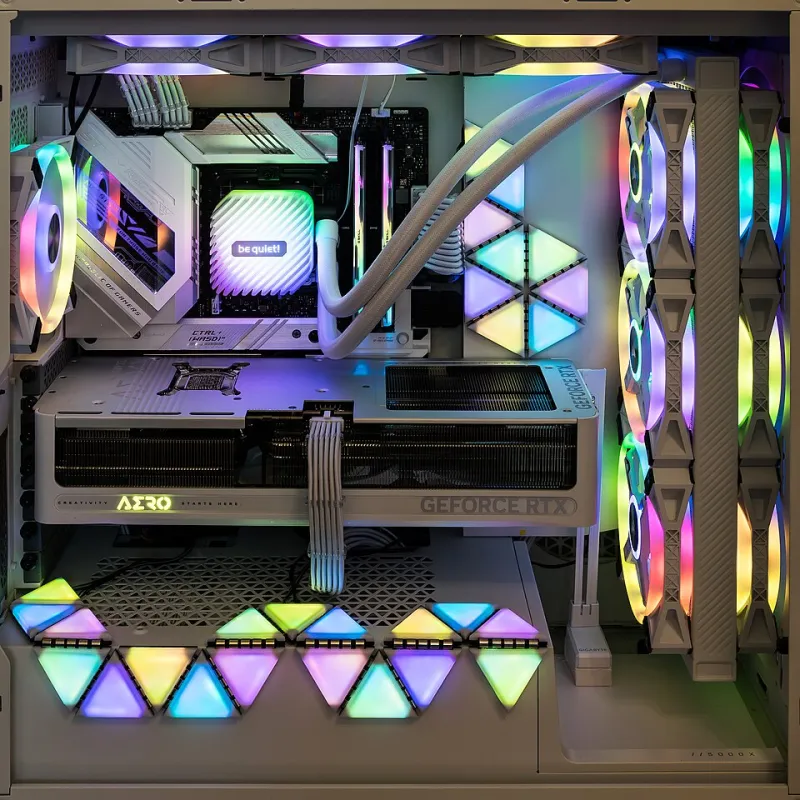
Photo: Jacek Halicki, CC BY-SA 4.0, via Wikimedia Commons
At any given moment, tens of millions of high-performance gaming PCs across the United States are sitting idle—fans spinning slowly, GPUs cooling down after a late-night session of Cyberpunk 2077 or Call of Duty. For most of their owners, these machines represent a sunk cost. For a growing cohort of technology startups, they represent something else entirely: a distributed supercomputer waiting to be switched on.
The commercial AI boom has created an almost insatiable appetite for GPU-based compute. Training large language models, running computer vision pipelines, and fine-tuning diffusion models all demand the same type of parallel processing power that makes a graphics card render realistic shadows at 144 frames per second. That architectural overlap has not gone unnoticed by entrepreneurs who see an arbitrage opportunity between the underutilized hardware sitting in American living rooms and the sky-high rates charged by AWS, Google Cloud, and Microsoft Azure.
The Technical Foundation of Distributed GPU Networks
Building a marketplace on top of heterogeneous consumer hardware is considerably more complex than it might appear. Companies operating in this space must solve several distinct engineering challenges simultaneously.
First, workload orchestration. AI training jobs are not monolithic—they can often be decomposed into discrete tasks that execute independently before results are aggregated. Frameworks such as Ray and Apache Spark have made this kind of distributed execution more accessible, but adapting them for hardware that may go offline without warning requires additional fault-tolerance layers. A node dropping out mid-job because a gamer decided to fire up a session cannot corrupt the broader training run.
Second, network latency. Consumer internet connections in the US vary enormously, from gigabit fiber in dense urban markets to cable connections in suburban areas with meaningful upload constraints. Gradient synchronization during model training is particularly sensitive to latency spikes, which means platform operators must be selective about which workloads they route to consumer nodes versus dedicated data center infrastructure.
Third, verification and trust. When an enterprise customer pays for compute, they need confidence that the work was actually performed correctly. Several platforms have adopted cryptographic verification schemes—borrowing concepts from blockchain-adjacent research—to produce tamper-resistant proofs of computation without revealing proprietary training data.
Companies such as Crusoe Energy have approached the problem from a slightly different angle, initially focusing on stranded energy assets like flared natural gas before broadening their infrastructure thesis. Livepeer, meanwhile, built its proof-of-concept around video transcoding—a more forgiving workload than AI training—before the economics of generative AI reshaped the competitive landscape.
What Participants Actually Earn
The earnings picture for individual contributors is nuanced. Platform operators typically quote figures in terms of GPU-hours, with consumer-grade cards like the NVIDIA RTX 4090 commanding somewhere between $0.35 and $0.80 per hour depending on network demand and the specific workload type. A participant running their rig for eight idle hours per night could theoretically generate between $85 and $190 per month—before accounting for electricity costs.
Electricity is not a trivial variable. An RTX 4090 running at full load draws approximately 450 watts. At the US average residential rate of roughly $0.16 per kilowatt-hour, that translates to about $0.07 per hour in energy expenditure. The margin remains positive in most scenarios, but it narrows considerably in high-rate states like California or Connecticut, where residential electricity can exceed $0.30 per kilowatt-hour.
Participants in online communities dedicated to these platforms report monthly net earnings ranging from $40 to $150 for a single high-end GPU, with significant variance based on location, hardware generation, and how consistently the machine remains available. These figures are meaningful supplemental income for some contributors, but they fall short of the aspirational numbers that some platform marketing materials have implied.
The Competitive Moat Problem
For the startups building these networks, the fundamental strategic question is whether distributed consumer hardware can carve out a durable position against hyperscale competition. The major cloud providers have several structural advantages that are difficult to neutralize: purpose-built data center infrastructure, long-term chip supply agreements with NVIDIA and AMD, enterprise sales relationships, and regulatory compliance certifications that many large customers require.
Distributed networks counter with a different value proposition. Marginal cost economics work in their favor when the underlying hardware has already been purchased by consumers for other purposes. There is no capital expenditure to amortize on the supply side. Additionally, the geographic distribution of consumer nodes can reduce latency for inference workloads that need to operate closer to end users—a structural advantage in use cases like real-time AI applications.
The most credible near-term opportunity for these platforms may not be displacing AWS for enterprise AI training but rather serving the long tail of startups, researchers, and independent developers who find hyperscale pricing prohibitive. A machine learning researcher at a small university or a three-person AI startup iterating on a fine-tuned model has fundamentally different price sensitivity than a Fortune 500 company running production workloads.
Scaling Beyond the Niche
The path to the frequently cited $2 billion market opportunity requires solving the supply consistency problem. Enterprises evaluating distributed compute networks cite reliability as their primary concern. A platform that can guarantee service-level agreements comparable to traditional cloud infrastructure—even if it achieves that through a hybrid architecture that blends consumer nodes with leased data center capacity during peak demand—becomes significantly more attractive to buyers with real production requirements.
Several platforms are moving in exactly this direction, positioning consumer GPU networks as a burst layer that sits beneath a more stable core infrastructure. In this model, predictable baseline workloads run on dedicated hardware while consumer nodes absorb overflow capacity during high-demand periods. The economics of this hybrid approach are less dramatic than a pure peer-to-peer narrative, but they are considerably more defensible.
Regulatory and data privacy considerations will also shape how quickly enterprise adoption accelerates. Workloads involving personal data, healthcare information, or financial records face strict requirements about where computation occurs and who has access to it. Distributed networks that cannot offer verifiable geographic containment and access controls will remain locked out of substantial portions of the enterprise market regardless of their price competitiveness.
The idle compute economy is real, and it is growing. Whether the startups currently building its infrastructure can convert that growth into durable, scalable businesses depends on their ability to close the reliability gap—and to persuade enterprise buyers that a gaming PC in Phoenix or Pittsburgh can be as trustworthy as a rack in a Tier 4 data center.