Turning Dark Hardware Into a Competitive Moat: The Rise of the Enterprise Internal Cloud
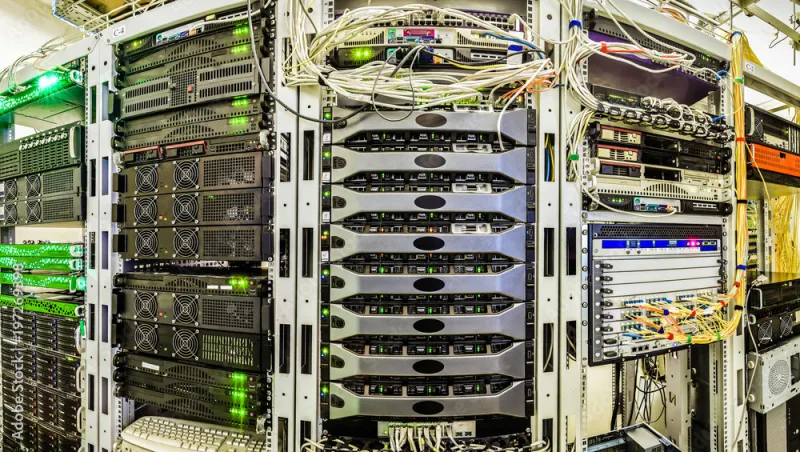
Photo: enterprise server room hardware racks internal data center, via as2.ftcdn.net
For years, the default answer to compute scarcity inside a growing enterprise was simple: provision more cloud capacity. Spin up additional instances, negotiate a reserved pricing tier, and absorb the cost as a line item under infrastructure. That logic held when hardware across the organization was genuinely underutilized in ways that were difficult to measure or aggregate. It no longer holds as cleanly as it once did.
A growing cohort of mid-market companies — firms with 500 to 5,000 employees, distributed office footprints, and heterogeneous hardware estates — is discovering that the compute they need is frequently already owned. It is simply sitting idle in finance department workstations, underloaded rack servers in regional offices, and engineering machines that run at single-digit CPU utilization for the majority of the workday. The opportunity, as several enterprises have begun to demonstrate, lies in aggregating that dormant capacity into something that behaves like an internal cloud.
The Utilization Gap Nobody Talks About
Enterprise hardware utilization rates have been an open secret in IT circles for decades. Servers provisioned for peak-load scenarios routinely operate at 15 to 25 percent average utilization. Workstations assigned to knowledge workers — particularly in roles that are documentation-heavy or meeting-intensive — may sustain meaningful CPU activity for fewer than three hours of an eight-hour shift. Multiply that pattern across several hundred machines in a mid-sized organization, and the aggregate idle capacity begins to resemble a respectable compute cluster.
The challenge has historically been orchestration. Individual idle machines are not useful in isolation. What transforms them into a coherent resource is the software layer that discovers available capacity, routes workloads intelligently, enforces security boundaries, and handles the inevitable variability of machines coming online and offline as employees begin and end their workdays. That software layer, once the exclusive province of research institutions and hyperscalers, has matured considerably.
What the ROI Calculation Actually Looks Like
Consider a manufacturing firm with 800 workstations distributed across three facilities. Each machine carries a replacement value of roughly $1,200 and runs standard productivity software. During off-hours — evenings, weekends, and the overnight window from approximately 11 PM to 6 AM Eastern — the vast majority of those machines are powered on but computationally dormant.
If the organization runs batch analytics, model training, document processing, or internal rendering workloads, those jobs are typically queued for cloud execution at on-demand rates. A modest internal compute network drawing on even 20 percent of that dormant hardware estate could deliver processing capacity equivalent to dozens of cloud instances — capacity the organization has already paid for in the form of hardware acquisition, power infrastructure, and facilities.
The capital expenditure is sunk. The marginal cost of putting that capacity to work is primarily the orchestration software, the internal networking configuration, and the engineering hours required to integrate existing workloads. For organizations running recurring batch processes, the payback period on that investment is frequently measured in months rather than years.
Implementation Challenges That Deserve Honest Attention
The economics are attractive. The implementation is not trivial, and enterprises that approach this transition without acknowledging its complexity tend to encounter predictable friction.
Security segmentation is the first serious consideration. Workloads routed through employee workstations must be isolated from the local user environment. An internal compute network that inadvertently exposes sensitive batch data to a workstation's local file system — or that creates lateral movement risk across the corporate network — introduces liabilities that offset the financial gains. Proper containerization and network policy enforcement are non-negotiable prerequisites.
Scheduler sophistication is the second challenge. A naive scheduler that simply floods available machines with jobs will collide with business operations the moment an employee arrives at their desk to find their workstation sluggish. Production-grade internal compute orchestration requires priority queuing, resource reservation thresholds, and real-time responsiveness to machine state changes. The scheduler must be a good tenant on every machine it touches.
Finally, governance and visibility matter more than most IT teams anticipate. Stakeholders across departments will ask which machines are contributing capacity, what workloads are running on them, and whether participation affects device warranties or compliance posture. Establishing clear ownership, audit trails, and opt-in policies at the department level is as important as the technical configuration.
The Competitive Dimension
What makes the internal cloud model particularly interesting for mid-market companies is not just cost reduction — it is the insulation it provides from public cloud pricing volatility and vendor dependency. Organizations that have not yet committed to deep integrations with a single hyperscaler retain meaningful flexibility. Building internal capacity reinforces that flexibility rather than eroding it.
There is also a talent dimension. Engineering teams that build and operate internal distributed compute infrastructure develop capabilities that are directly transferable to broader distributed systems work. The internal cloud becomes a proving ground for architectural patterns — fault tolerance, workload distribution, capacity forecasting — that compound in value over time.
For companies operating in cost-sensitive verticals such as logistics, regional healthcare, and specialty manufacturing, the margin impact of reducing cloud spend by 30 to 50 percent on recurring compute workloads is material. In competitive markets where technology infrastructure is a meaningful cost driver, that advantage is not theoretical.
What This Means for the Market
The emergence of enterprise internal clouds built from idle hardware does not signal a retreat from distributed computing as a concept. If anything, it reflects a broader maturation of distributed computing thinking — one that recognizes the network of available machines is larger than any single vendor's catalog, and that the most cost-effective node in a compute job might be one the organization already owns.
Platforms designed to facilitate idle compute allocation, including those that span both internal hardware and external peer capacity, are well-positioned to serve as the connective tissue in this evolving architecture. The hardware is already in place. The workloads are already queued. The question is simply whether enterprises choose to route them intelligently.