Wasted Watts: How Idle Infrastructure Is Quietly Reshaping the Sustainability Calculus for Enterprise Computing
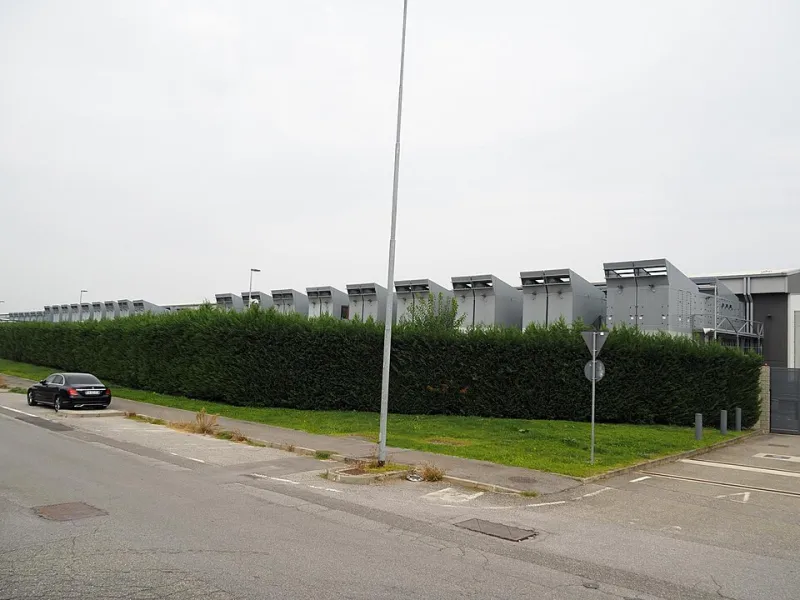
Photo: Lapalmauz, CC BY-SA 4.0, via Wikimedia Commons
For decades, the prevailing assumption in enterprise IT has been straightforward: more hardware means more capability. Build the data center large enough to handle peak demand, keep the servers running continuously, and worry about utilization rates later. The environmental consequences of that philosophy, however, are no longer easy to ignore.
According to the Lawrence Berkeley National Laboratory, US data centers consumed approximately 200 terawatt-hours of electricity in a recent measured year—roughly 1.8 percent of total national electricity consumption. A substantial portion of that energy powered servers operating well below their intended capacity. Industry estimates suggest the average server utilization rate across enterprise environments hovers between 5 and 15 percent during typical business hours, and drops even further overnight and on weekends. The hardware keeps running. The electricity meters keep turning. The carbon emissions accumulate.
Distributed computing networks, which aggregate idle processing capacity from participating machines across geographically dispersed locations, represent a fundamentally different architectural philosophy—and an increasingly credible sustainability argument.
The Utilization Problem Is Larger Than Most Enterprises Acknowledge
Enterprise sustainability officers have long grappled with the tension between operational resilience and energy efficiency. Overprovisioning servers is standard practice precisely because the cost of insufficient capacity during a demand spike is considered catastrophic, whereas the cost of running idle hardware has historically been treated as a fixed and acceptable overhead.
That calculus is shifting. "We began measuring our actual utilization rates about three years ago, and the results were genuinely uncomfortable," said one chief sustainability officer at a mid-sized financial services firm in the Chicago area, who requested anonymity to speak candidly about internal infrastructure assessments. "We were powering infrastructure around the clock to handle workloads that materialized, at most, forty hours per week. The rest of the time, we were essentially paying to heat the room."
The carbon implications extend beyond the data center floor. Tens of millions of personal computers, developer workstations, and professional laptops across the United States remain powered on during off-hours, drawing between 30 and 150 watts continuously while performing no productive computation. Aggregated across an organization of even modest size, this represents a non-trivial emissions contribution that rarely appears in formal sustainability reporting.
Distributed Networks as an Emissions Offset Strategy
The core premise of distributed idle compute networks is deceptively simple: rather than allowing that dormant processing capacity to dissipate as waste heat, redirect it toward productive workloads. The environmental argument follows directly. If a workload can be completed using hardware that is already powered on and already consuming electricity, the marginal carbon cost of that computation approaches zero.
Contrast this with the alternative. Spinning up a dedicated cloud instance to handle a batch processing job requires provisioning new virtual infrastructure, which in practice means activating additional physical server capacity at a hyperscale data center. Even the most energy-efficient hyperscale facilities carry a carbon cost per compute unit. Distributed networks, by consuming capacity that would otherwise be wasted, sidestep that cost almost entirely.
A sustainability analyst at a Pacific Northwest technology company, speaking at a recent enterprise infrastructure forum, offered a concrete illustration. Her team modeled a scenario in which a 500-node distributed compute network, drawing exclusively from already-powered devices during off-peak hours, handled a recurring machine learning preprocessing workload. Compared to provisioning equivalent capacity through a conventional cloud provider operating at average US grid carbon intensity, the distributed approach reduced associated emissions by an estimated 340 metric tons of CO2-equivalent annually. "That's not a rounding error," she noted. "That's a meaningful line item in a corporate sustainability report."
The Measurement Challenge and Why It Matters for Reporting
For enterprise sustainability teams pursuing Science Based Targets or preparing disclosures aligned with frameworks such as the Task Force on Climate-related Financial Disclosures, the ability to quantify emissions reductions is not merely academic—it is a compliance and reputational imperative.
Distributed computing networks that provide granular telemetry on energy consumption per compute job offer something traditional cloud providers have been slow to deliver: workload-level carbon accounting. When an enterprise can demonstrate that a specific data processing task consumed X kilowatt-hours drawn from already-active hardware rather than Y kilowatt-hours of newly provisioned capacity, the sustainability case becomes auditable rather than theoretical.
Several distributed compute platforms have begun developing reporting dashboards specifically designed to integrate with enterprise environmental management systems, generating outputs compatible with the Greenhouse Gas Protocol's Scope 2 and Scope 3 accounting categories. For procurement and sustainability teams navigating increasingly stringent ESG disclosure requirements, this capability is moving from a differentiating feature to an expected standard.
Organizational and Technical Considerations for Enterprise Adoption
Adopting distributed idle compute as part of an enterprise sustainability strategy is not without complexity. Security and data governance requirements must be carefully mapped before any workload is routed through external distributed infrastructure. Not every computation is appropriate for distributed execution—tasks involving sensitive personal data, regulated financial information, or proprietary intellectual property require rigorous evaluation before deployment outside controlled environments.
Workload suitability is another practical constraint. Distributed networks are particularly well-suited to parallelizable tasks: rendering, simulation, data transformation, model training on non-sensitive datasets, and similar batch workloads. Latency-sensitive applications or tightly coupled processes that require continuous inter-node communication are generally poor candidates.
For organizations that operate significant internal device fleets—development teams with hundreds of high-specification workstations, for instance—contributing idle capacity to a curated internal or semi-private distributed network can capture sustainability benefits while maintaining tighter governance controls than fully public participation would allow.
A Structural Shift, Not a Marketing Narrative
The framing of idle compute networks as a green technology solution is not, at its core, a marketing exercise. The efficiency argument is structural. Any system that performs equivalent computation while consuming energy that was already being expended is, by definition, more efficient than a system requiring additional energy expenditure to accomplish the same outcome.
As enterprise sustainability commitments deepen and regulatory pressure around emissions reporting intensifies, infrastructure decisions that were once evaluated purely on performance and cost grounds are increasingly subject to environmental scrutiny. Distributed idle compute networks offer something rare in enterprise technology: a proposition where the economic efficiency argument and the environmental argument point in exactly the same direction.
For sustainability officers seeking credible, measurable interventions that do not require wholesale infrastructure replacement, that alignment may prove to be the most compelling pitch of all.